
They Asked Us To Build An Event Marketplace.
We Ended Up Automating The Entire Booking Journey.
But after mapping how bookings actually happen, we realized finding a vendor wasn't the difficult part.




5
Core modules
4
Integrations
3-way
Payment split
Project Snapshot
- Industry
- Events & Hospitality
- Platform
- Vendor & Planner Marketplace
- Focus
- Marketplace & Booking Process Automation
- Integrations
- Stripe Connect · Supabase · Resend · Capacitor
- Core Modules
- • Vendor Portal• Marketplace• Booking Engine• Payments• Admin Portal
The brief
The original request sounded simple.
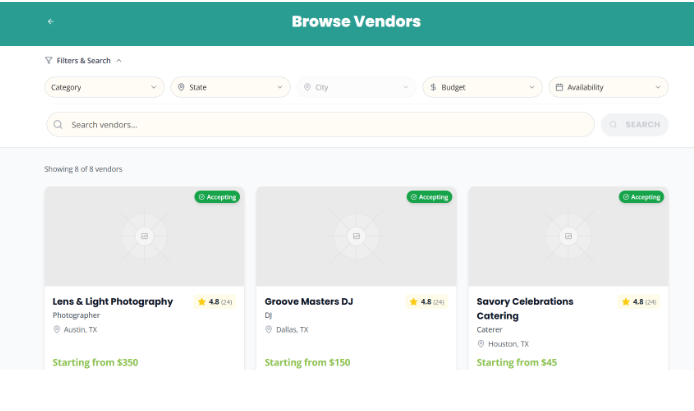
Build a marketplace where event planners could discover vendors.
Browse profiles. Request bookings. Complete payments.
It looked like a fairly standard marketplace.
But after mapping how bookings actually happen, we realized finding a vendor wasn't the difficult part.
Everything that happened after clicking Book was.
Finding A Vendor Was Only The Beginning
Availability
Booking requests
Vendor approval
Payments
Payouts
Notifications
A planner can find a photographer or DJ in minutes.
The real work starts afterwards.
Availability. Booking requests. Vendor approval. Payments. Payouts. Notifications. Cancellations.
Every booking requires both parties to stay synchronized.
Without one connected workflow, vendors quickly end up juggling emails, spreadsheets, calendars, and payment confirmations.
What We Discovered
The client didn't need another marketplace.
They needed one platform that could coordinate vendors, planners, bookings, and payments from beginning to end.
Engineering Note
We intentionally separated the booking request from payment. Planners don't pay immediately—vendors first review and accept the request before any money changes hands.
Finding a vendor wasn't the difficult part. Everything that happened after clicking Book was.
Accepting A Booking Became The Trigger For Everything
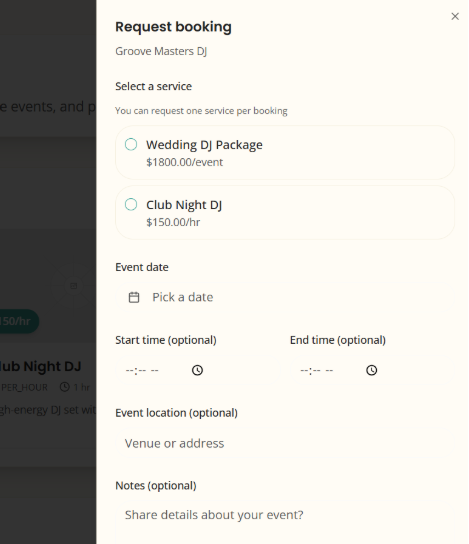
Booking request workflow
Service selection, event date, time, location, and notes submitted as a booking request before payment is initiated.
Engineering Note
Separating booking requests from payments dramatically simplified cancellation handling while creating a much better experience for both planners and vendors.
One of the first operational challenges we uncovered was the booking flow itself.
Initially, it seemed logical to collect payment as soon as someone booked.
But that's not how vendors work. Availability changes. Schedules overlap. Requests need reviewing.
Instead, bookings became a workflow.
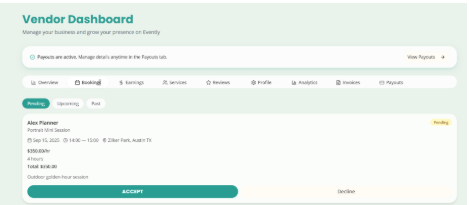
Planner submits a request. Vendor reviews it. If accepted, the platform automatically prepares payment. If declined, the planner is notified immediately.
That one change removed unnecessary refunds while giving vendors complete control over their schedules.
Payments Needed To Work For Three Businesses
Unlike a traditional checkout, every payment involved three parties. The planner. The vendor. The marketplace.
The platform needed to collect payment securely, deduct its commission automatically, and transfer the remaining balance to the vendor.
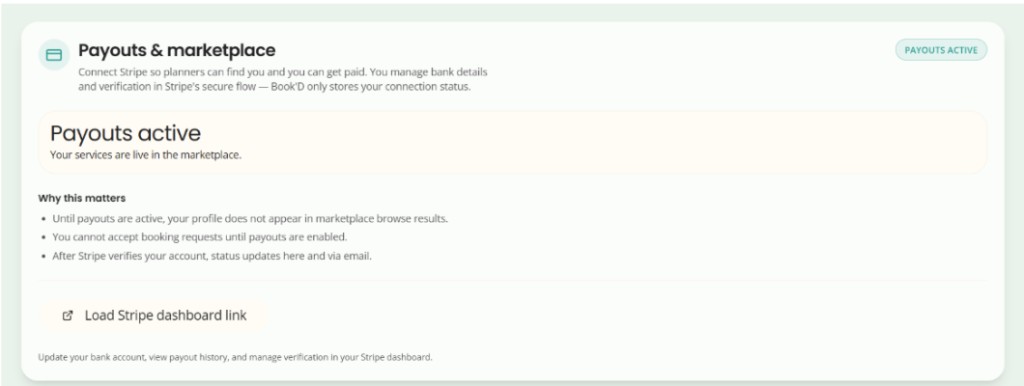
Instead of manually calculating payouts, Stripe Connect became part of the operational workflow.
Once payment succeeds, platform fees are deducted automatically and vendor payouts happen through Stripe without administrative work.
Behind The Scenes
Stripe Connect onboarding is completed during vendor registration, allowing compliant payouts without storing sensitive banking information inside the platform.
Vendor Profiles Became Small Businesses
Another interesting discovery came during vendor onboarding.
A vendor profile isn't just a business card.
It needs pricing. Portfolio images. Travel radius. Availability. Business categories. Service descriptions.
Everything required for planners to make confident booking decisions.
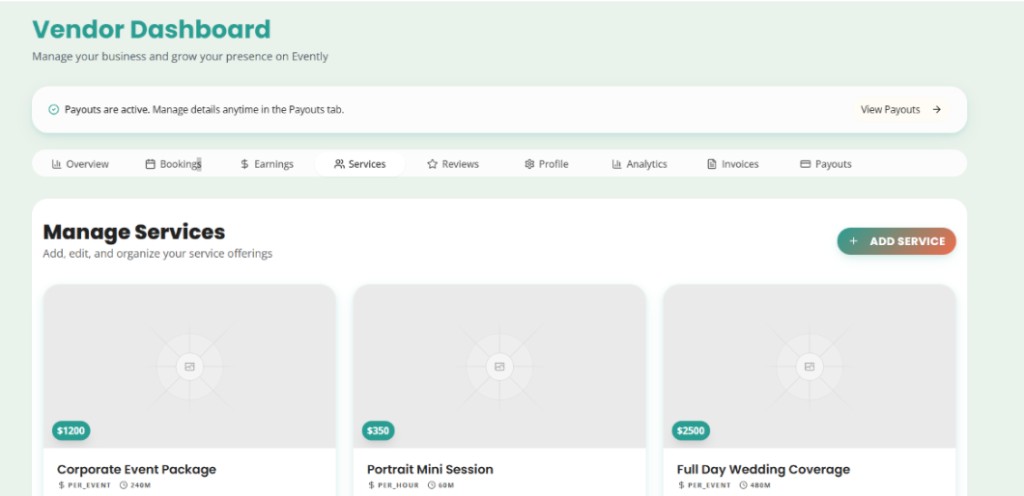
Instead of treating profiles as static pages, we built a complete vendor management system where businesses can continuously update their services without administrator involvement.
Engineering Note
Vendor portfolios, service listings, pricing, travel fees, and media are managed independently, allowing businesses to update offerings without affecting existing bookings.
Service catalog with per-event and per-hour pricing, duration settings, and self-service vendor profile management.
Communication Needed To Happen Automatically
Request submitted
Booking accepted
Payment completed
Cancellation
Reminder
Bookings generate constant communication.
Request submitted. Booking accepted. Payment completed. Cancellation. Reminder.
Every one of these events normally creates another email.
Rather than asking vendors to keep everyone updated manually, the platform automatically notifies planners and vendors throughout the booking journey.
Everyone knows exactly what's happening without additional administrative work.
Engineering Note
We chose email-first notifications using Resend, with lightweight in-app notifications for MVP, avoiding unnecessary real-time infrastructure while keeping users informed.
Simple Scheduling Was Better Than Complex Calendars
It was tempting to build a full calendar system.
But during planning we realized that would slow the MVP without solving the core business problem.
Instead, vendors define simple availability windows. The platform checks for obvious booking conflicts. Vendors remain in control of accepting requests.
The result is a booking system that's significantly simpler to maintain while still preventing common scheduling issues.
One Design Decision
Basic availability validation was intentionally chosen over advanced calendar synchronization, reducing complexity while still preventing double bookings during the MVP.
The Outcome
Planners discover vendors.
Vendors manage their services.
Booking requests follow structured workflows.
Payments happen only after approval.
Payouts are automated.
Communication happens automatically.
What started as an event marketplace became a complete booking operations platform.
Instead of simply connecting planners with vendors, the platform automates everything that happens between the first booking request and the final payout.
Explore The Demo
Experience the platform from both the Planner and Vendor perspectives, and see how discovery, bookings, payments, notifications, and vendor management work together inside one connected marketplace.